
LaFolia DIY Magnetostatic Ribbon Loudspeaker Project
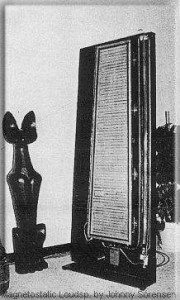
Are you interested in high fidelity, or just in a serious DIY project? Then this La Folia site might be what you are looking for.
This site has been online since 1996. It is a step-by-step guide to a pair of homemade flat magnetic ribbon speakers. I have included my own build story, the original Danish recipe, diagrams, references, and a list of materials.
La Folia, and these planar units, come from a design developed in Denmark by Ole Thofte. He wrote me a few emails in the distant past, all of them positive, luckily. Publishing this site was fine with him. Phew.
It is a real do-it-yourself project. Easy enough for a complete beginner. I am the proof. Cheap enough that you will not go into debt trying it. You can start with almost nothing and test the idea. More on that is in my experience.
Be warned. You might get bitten, and then at least 100 hours disappear into your own planar speakers. Time is scarce. If you catch LaFolitis, do not blame me.
What are these things?
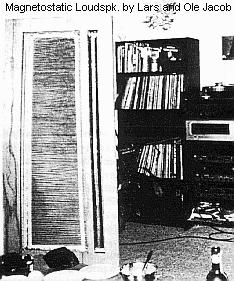
Many people ask what on earth a magnetostatic planar ribbon loudspeaker is. Magnetostat, for short.
Look at the photo and you get a first idea. Read the rest of the site and the idea becomes clear.
In a few words, they are flat loudspeakers. The membrane is flat and stretched, not a cone, with a conductor stuck on it, sitting in a magnetic field made by a large number of magnets.
They are also a down-to-earth shortcut to serious hi-fi, if you are not scared of some work and a bit of adventure.
What makes the project attractive is the low cost, and a sound that would normally ask for about ten times the money. Commercial speakers already use the same principle. The extra is the feeling of a speaker you built yourself.
You also have to live with the limits. Sensitivity is low. They want power. An amplifier without a fuse or a relay can be damaged if the load looks like a short. They are large, and in a small room they are hard to place, sometimes impossible. I am fairly sure they have been blamed for more than one divorce, so tread lightly.
Underneath, they use the same idea as an ordinary loudspeaker. Instead of a cone, you use a flat membrane stretched over an MDF frame. Instead of a copper coil in a magnet, you use a long, thin aluminium foil strip cut to a specific design, sitting in a field from ordinary flat magnets stuck to a perforated iron plate.
Anyone can build them. You need patience, a few tools, about 500 US dollars, some dexterity, hard work, and ordinary sense. That is the special skill. You can do it.
They are also a proven idea, not something a few hi-fi people pulled out of a hat. Apogee, Magnepan, DALI, and Carver, among others, have used the same principle.
Can I build a pair?
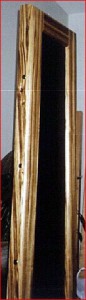
This is more than an experiment. It is a proven DIY project, with a lot of work already behind it. I learned about it while living in Denmark in the mid-eighties, when the original article appeared in High Fidelity, a Danish monthly.
I quote from several Danish magazines, where the speakers were called La Folia. I do not claim authorship. I was the first person to publish the project online, so more DIY people could use it, and so the pool of experience would grow.
I include the build notes for my own pair, which I listened to every day while I lived in Chile. I could not take them with me when I left, so they went to someone who bought my NAD 3300 amplifier.
I changed a few things in the original design and in the way it is built. Some of that is in the build story. Some of it is in the notes on each chapter.
If you have another idea, or another project, I would like to hear about it and add it to the resources. I even expected a few Scandinavians to write. Some did, with newer ideas, projects, and sites.