
The original La Folia Magnetostatic Loudspeaker recipe (plus modifications)
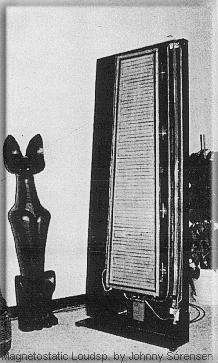
In its original 1989 design, the loudspeakers were notoriously inefficient (70 – 72 dB SPL @ 1W/1m), demanding high-current monster amplifiers just to reach moderate listening levels.
The basic acoustic concept behind the project mirrors legendary benchmark designs in high-end audio history: Strathearn, Fostex, Magnepan (Magneplanar), and particularly Apogee Acoustics. It is in many ways an accessible, build-it-yourself interpretation of Apogee’s full-range ribbon systems. Bob Carver, in collaboration with friends of the original Danish designer Ole Thofte, went on to manufacture commercial ribbon speakers using these exact magnetic geometry principles.
The Original 16-Step Recipe
- Cut the Wood Pieces: Cut the baffle plates, one being the exact mirror image of the other for stereo symmetry.
- Resonance Damping: Apply damping foam to the top and bottom perimeters of the woofer opening. Do not use overly thick foam, or stretching the membrane cleanly will become nearly impossible and wrinkle formation will ruin the panel tension.
- Cut the Tweeter Aperture: Cut the narrow ribbon slot taking into consideration the magnet dimensions and the steel side strips lining the aperture.
- Prepare the Metal Backing Plate: Fabricate the perforated steel plate. Cut the trapezoidal plate to fit the woofer opening and prepare the narrow backing strip for the tweeter channel.
- Mount the Magnets: Position the magnets on the perforated plate following the alternating N-S-N-S grid layout. Ensure your conductor path length results in an amplifier-friendly 3.5 Ω – 4.0 Ω load. With decent magnets, their own magnetic attraction to the steel plate holds them securely in place.
- Diaphragm Tensioning: Prepare and stretch the Mylar/Kapton membrane. This requires patience and methodical tensioning around the perimeter jig.
- Magnetic Phase Matching: The row of woofer magnets closest to the tweeter aperture must share the same polarity as the adjacent tweeter row. The tweeter magnets are double-stacked to boost gap flux density.
- Conductor Geometry: Conductor lanes must obey the collective driving principle: all conductors passing through a given magnetic field gap must carry current in the identical direction.
- Single Unbroken Woofer Trace: The woofer conductor routes continuously across the active area so the entire film moves as one unified planar surface.
- Woofer Conductor Dimensions: The original Danish project specified 18 meters of 9 mm wide aluminum foil (approx. 30 µm thick), yielding a flat 3.0 Ω DC resistance across 68 winding runs.
- Tweeter Ribbon Conductor: The original tweeter utilized a 9-meter long, 4.5 mm wide strip running across 4 parallel passes, also yielding approx. 3.0 Ω DC resistance.
- Ribbon Corrugation: The pure aluminum tweeter ribbon must be corrugated (crimped with a gear jig), causing it to shrink approx. 10% in length. Corrugation absorbs thermal expansion, prevents buzzing, and allows free excursion when reproducing transients.
- Crossover & Wiring: Connect the woofer and tweeter in parallel. Place a 0.95 mH inductor in series with the woofer and a 105 µF capacitor in series with the tweeter. The nominal impedance is an easy, almost purely resistive 3.5 Ω – 4.0 Ω.
- Pedestal Base / Stand: Build robust floor stands out of heavy timber or welded steel to support the weight of the steel backing plates.
- System Verification & Tuning: Check all terminals with a multimeter to verify no short circuits exist. Resistance at the speaker terminals should measure approx. 3.5 Ω. When you first power up your amplifier, adjust high-frequency balance by adding a small series resistor (0.5 Ω – 1.5 Ω) on the tweeter if treble output outpaces the woofer.
- HAVE LOTS OF FUN. I DID!
⚡ Modern Builder’s Notes (La Folia 2.0)
If you are constructing a La Folia speaker today, the materials science and digital audio tools available provide dramatic upgrades over the 1989 Danish prototype:
1. Modern Neodymium (NdFeB) vs. 1980s Ceramic Magnets
- Sensitivity Jump: The original build used weak ceramic ferrite magnets, resulting in an anemic 70–72 dB/W/m efficiency. Replacing them with modern NdFeB grade N42 or N48 bar magnets increases magnetic gap flux density (B) by nearly 300%.
- Result: System sensitivity jumps to 84 – 88 dB/W/m, transforming the speaker from an amplifier-killer into a speaker that sings effortlessly on modest 60W–100W amplifiers.
2. Modern Transfer Adhesives vs. Spray Glue
- Original builders used 3M Super 77 spray adhesive, which tends to soften and turn gummy as voice-coil traces heat up during spirited listening sessions. Over time, this leads to trace delamination and buzzing.
- Modern Solution: Use 3M 467MP or 468MP High-Performance Acrylic Transfer Tape. These pressure-sensitive films maintain adhesion past 150°C (300°F), provide uniform thickness, and create zero aerosol overspray mess.
3. Active DSP Crossovers (miniDSP / CamillaDSP)
- While the original 0.95 mH + 105 µF passive network is simple, passive capacitors of 105 µF are bulky, expensive, and subject to insertion loss.
- Modern Solution: Bi-amp the panels using a digital signal processor (such as a miniDSP 2x4 HD or open-source CamillaDSP on a Raspberry Pi):
- Apply steep 24 dB/octave Linkwitz-Riley (LR4) crossover slopes at 450–550 Hz, protecting the delicate ribbon tweeter from low-frequency over-excursion.
- Apply millisecond acoustic time-delay alignment between the woofer and tweeter.
- Dial in parametric dipole baffle-step equalization (boosting 30–60 Hz bass without passive power waste).
4. Flex-PCB Planar Diaphragms
- Rather than painstakingly hand-gluing individual aluminum foil lanes, modern hobbyists can order computer-designed Flexible Printed Circuits (FPC / Flex-PCB) on ultra-thin polyimide from prototype board houses (JLCPCB, PCBWay).
- Yields sub-millimeter trace precision, identical stereo resistance matching, and zero risk of trace detachment.